
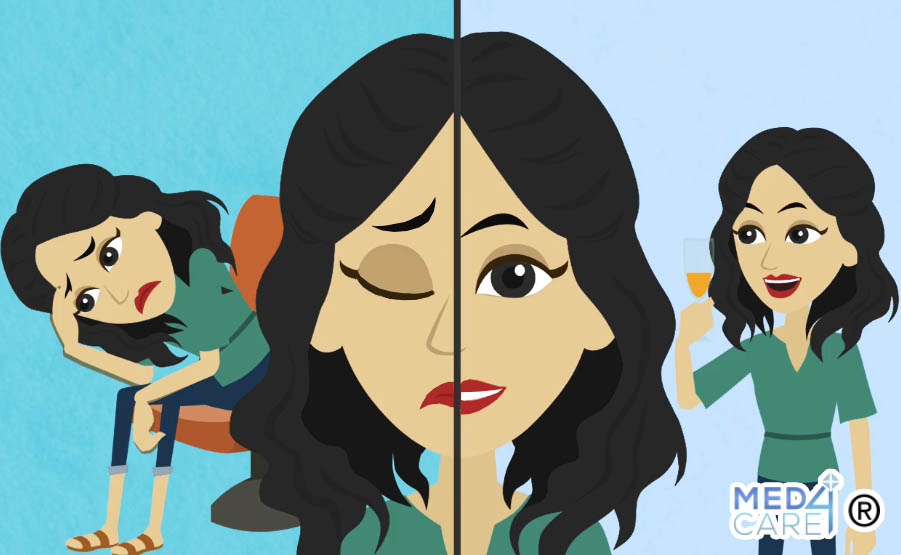
Bipolar disorder: how to recognize it, why it needs long-term treatment, which medicines and psychotherapies work, and the warnings on valproate.
Bipolar disorder, sometimes simply called “bipolar”, is a mood disorder in which periods of depression alternate with periods of elation and excessive energy. It is not simply a “moody” temperament: it is a chronic condition, which often begins at a young age and which, with the right treatment, can be kept under control for many years.
If you are having thoughts of ending your life
If right now you are thinking of taking your own life or of harming yourself, do not stay alone.
In the United States:
- call 911 in a life-threatening situation, or go to the nearest emergency room;
- 988 Suicide & Crisis Lifeline: call or text 988, or chat online at 988lifeline.org: free, confidential, 24 hours a day, 7 days a week; veterans can call 988 and press 1.
In the United Kingdom:
- call 999 if your life or someone else's is at risk;
- NHS 111: call 111 and select the mental health option, or use 111 online, to be told where to get the right help;
- Samaritans: 116 123, free, day or night, 365 days a year.
Talking about it with your doctor or with someone you trust is the first step.
What is bipolar disorder
In bipolar disorder, episodes of very low mood, similar to depression, alternate with episodes of elevated or irritable mood, with a lot of energy and little need for sleep. Between one episode and the next, many people are well for long periods.
There are three main forms:
- bipolar I disorder: at least one manic episode, that is, a phase of intense euphoria or irritability that lasts for days, disrupts everyday life and sometimes requires hospital admission;
- bipolar II disorder: depressive episodes alternating with hypomanic episodes, which are milder and shorter than mania;
- cyclothymia: milder but persistent mood swings, for at least two years.
How common is it
According to the World Health Organization, in 2023 about 36 million people were living with bipolar disorder, 0.4% of the world's population. Studies that also consider less severe forms and the whole lifespan arrive at higher estimates, over 1% of the population. The illness is one of the leading causes of disability in young people.
Causes
Bipolar disorder arises from the combination of a biological predisposition and environmental factors. Family history is the most important factor: having a parent or a sibling with the disorder increases the risk. Factors that can trigger an episode include stress, loss of sleep, disrupted daily routines and the use of alcohol and drugs.
Symptoms
The depressive phase
In the depressive phase there is sadness, loss of interest, tiredness, sleep problems, difficulty concentrating, feelings of guilt and, sometimes, thoughts of death. It is often the longest phase and the one that weighs most on the person's life.
The manic and hypomanic phase
In mania, the person feels full of energy, sleeps only a few hours without feeling tired, talks a lot and fast, jumps from one idea to another, has excessive self-esteem and may make risky decisions, for example impulsive spending. In severe forms, psychotic symptoms may appear. Hypomania has the same symptoms in a milder form, and people who experience it often do not recognize it as a problem.
Mixed episodes
In mixed episodes, depressive and manic symptoms are present at the same time: for example, very low mood with agitation and insomnia. These are particularly delicate phases because of the risk of self-harm.
The risk of suicide
Bipolar disorder is one of the illnesses with the highest risk of suicide. A systematic review of 61 studies estimated that the risk of death by suicide is about 20 to 30 times higher than in the general population. Factors that increase it are early onset, previous attempts, suicide in the family and other associated illnesses. Lithium is the medicine that has most clearly shown a protective effect: in a meta-analysis of 48 randomized trials it reduced the number of suicides compared with placebo.
How it is diagnosed
The diagnosis is clinical and is based on the person's history, taken by the psychiatrist also with the help of family members, who often remember the phases of euphoria better. It is difficult because the illness usually begins with a depressive episode, which can look like ordinary depression: for this reason, when faced with depression, the doctor always looks for signs of past hypomanic episodes. There are no blood tests or imaging tests that confirm the diagnosis; they are used, however, to rule out other causes, such as thyroid disease or substance use.
Treatment
Medication
Medication is the foundation of treatment and, in most cases, continues for a long time even when the person is well, to prevent relapses. The most widely used international guidelines, the Canadian ones and those of the International Society for Bipolar Disorders, recommend as first choice, depending on the phase:
- mood stabilizers: lithium, the reference medicine especially for preventing relapses; valproate, used in mania and in maintenance; lamotrigine, indicated mainly in the depressive phase and in maintenance;
- second-generation antipsychotics: quetiapine, useful both in mania and in bipolar depression; lurasidone for the depressive phase; aripiprazole, risperidone, asenapine and cariprazine for mania.
Lithium requires regular blood tests to check its concentration and kidney and thyroid function. Antidepressants are used with caution and, according to the guidelines, not on their own, because they can trigger a switch to a manic phase; the guidelines generally advise against them in maintenance treatment. Other anticonvulsants, such as carbamazepine, are used in selected cases.
The warning on valproate
Valproate can seriously harm the baby if taken during pregnancy. In the United States, the prescribing information for Depakote (divalproex sodium) approved by the Food and Drug Administration (FDA), last revised in March 2026, carries a boxed warning: valproate can cause major congenital malformations, particularly neural tube defects such as spina bifida, as well as decreased IQ scores and neurodevelopmental disorders after exposure in the womb. According to the label, the rate of congenital malformations in babies born to mothers taking valproate is about four times higher than in babies born to mothers with epilepsy taking another anti-seizure medicine on its own. For this reason, according to the FDA, valproate should not be used to treat women with bipolar disorder who are pregnant or who plan to become pregnant, and should not be given to a woman of childbearing potential, unless other medications have failed to provide adequate symptom control or are otherwise unacceptable; in such cases effective contraception should be used. The US label contains no specific precaution for men concerning their children: it mentions only reports of male infertility. In Europe, in 2024 the European Medicines Agency added precautions for men too, because of a possible risk of neurodevelopmental disorders in their children: treatment started and supervised by a specialist, effective contraception during treatment and for 3 months afterwards, no sperm donation. In June 2026 the European pharmacovigilance committee (PRAC) kept these precautions in place, noting that the data on men are conflicting and the role of valproate is uncertain. Anyone taking valproate must never stop it on their own: talk to your doctor before trying for a pregnancy.
Psychotherapy
Psychotherapy is added to medication, it does not replace it. A meta-analysis of 39 randomized trials showed that structured psychotherapies, combined with medication, reduce relapses. The most effective are group or family psychoeducation, which teaches people to recognize the first signs of a new phase and to manage the illness, cognitive behavioral therapy and family therapy. Regular sleep and daily routines are among the most useful tools.
Other treatments
In severe phases, or when medication does not work, electroconvulsive therapy, performed under general anesthesia, may be used. The use of antidepressants in maintenance treatment has also been studied, with results that limit their use (the Italian edition of Med4Care has an article on this topic). On transcranial direct current stimulation, studied mainly in depression, see our dedicated article.
What it means for the patient
I explain to patients and their families that bipolar disorder is treated like a chronic illness, similar to diabetes: with continuous treatment, regular check-ups and the ability to recognize the signs of a new phase early. Some practical points:
- do not stop your medication when you feel well: it is the most common cause of relapse;
- protect your sleep: sleepless nights can trigger a manic phase;
- avoid alcohol and drugs, which worsen the course of the illness;
- involve your family, who are often the first to notice changes;
- ask for help immediately if you have thoughts of death.
References
- World Health Organization. Bipolar disorder. Fact sheet, 11 September 2026. Accessed 21 October 2026. who.int
- Grande I, Berk M, Birmaher B, Vieta E. Bipolar disorder. The Lancet. 2016;387(10027):1561-1572. doi:10.1016/S0140-6736(15)00241-X. PubMed
- Yatham LN, Kennedy SH, Parikh SV, Schaffer A, Bond DJ, Frey BN, Sharma V, et al. Canadian Network for Mood and Anxiety Treatments (CANMAT) and International Society for Bipolar Disorders (ISBD) 2018 guidelines for the management of patients with bipolar disorder. Bipolar Disorders. 2018;20(2):97-170. doi:10.1111/bdi.12609. PubMed
- Keramatian K, Chithra NK, Yatham LN. The CANMAT and ISBD Guidelines for the Treatment of Bipolar Disorder: Summary and a 2023 Update of Evidence. Focus. 2023;21(4):344-353. doi:10.1176/appi.focus.20230009. PubMed
- Plans L, Barrot C, Nieto E, Rios J, Schulze TG, Papiol S, Mitjans M, et al. Association between completed suicide and bipolar disorder: A systematic review of the literature. Journal of Affective Disorders. 2019;242:111-122. doi:10.1016/j.jad.2018.08.054. PubMed
- Cipriani A, Hawton K, Stockton S, Geddes JR. Lithium in the prevention of suicide in mood disorders: updated systematic review and meta-analysis. BMJ. 2013;346:f3646. doi:10.1136/bmj.f3646. PubMed
- Miklowitz DJ, Efthimiou O, Furukawa TA, Scott J, McLaren R, Geddes JR, Cipriani A. Adjunctive Psychotherapy for Bipolar Disorder: A Systematic Review and Component Network Meta-analysis. JAMA Psychiatry. 2021;78(2):141-150. doi:10.1001/jamapsychiatry.2020.2993. PubMed
- U.S. Food and Drug Administration. Depakote (divalproex sodium) delayed-release tablets: full prescribing information, Boxed Warning (Fetal Risk), sections 5.2, 5.3, 5.4 and 8.3, revised 3/2026. Accessed 21 October 2026. accessdata.fda.gov
- European Medicines Agency. Precautionary measures to address potential risk of neurodevelopmental disorders in children born to men treated with valproate medicines, 26 January 2024. Accessed 21 October 2026. ema.europa.eu
- European Medicines Agency, PRAC. Signal assessment report on neurodevelopmental disorders after paternal exposure to valproate and related substances (EMA/PRAC/165641/2026), 11 June 2026. Accessed 21 October 2026. ema.europa.eu
- National Institute of Mental Health (NIMH), National Institutes of Health. Help for Mental Illnesses, last reviewed April 2026. Accessed 21 October 2026. nimh.nih.gov
- 988 Suicide & Crisis Lifeline. Get Help. Accessed 21 October 2026. 988lifeline.org
- NHS. Where to get urgent help for mental health, page last reviewed 26 April 2023. Accessed 21 October 2026. nhs.uk
- Samaritans. Contact us. Accessed 21 October 2026. samaritans.org

Dr. Marco De Nardin
Medical Doctor, Specialist in Anesthesiology, Intensive Care and Pain Management
Dr. Marco De Nardin is a physician specializing in Anesthesiology, Intensive Care, and Pain Management. He completed his medical degree and specialty training in Italy, where he continues to practice at his private clinics in Mestre (Venice) and Milan. With extensive clinical experience spanning operating rooms, intensive care units, and pain management clinics, Dr. De Nardin brings a unique perspective that bridges acute-care medicine with chronic disease management. His clinical practice focuses on regional anesthesia, ozone therapy, intravenous infusion therapy, and integrative approaches to pain treatment. He is the founder of Med4Care, a medical information platform delivering evidence-based, physician-reviewed health content. Every article published under his name reflects his commitment to making complex medical topics accessible to patients without compromising scientific rigor.


